An experience venue does most of its fourth-quarter business on decisions that are being made right now.
Office holiday parties get assigned to someone in late September and early October. Grandparents start asking what the kids would actually use. Group organizers begin shortlisting places for a December night out while there is still a choice of dates. By the time the season arrives, most of that decision-making has already happened somewhere a venue either did or did not appear.
That timing is what makes the fall different from the rest of the year. Marketing done in December competes for bookings that were settled in October. Marketing done in October shapes which venues make the shortlist at all.
This guide covers what to put in place over the next few weeks: the pages, the assets, the listing work and the ad spend that turn a busy quarter into a fully booked one. It applies to indoor golf, axe throwing, escape rooms, mini golf, breweries and event spaces, anywhere the product is the visit itself.
Work backwards from the booking, not the season
Most venue calendars have a lead time the marketing calendar ignores.
A walk-in decides in minutes. A group of eight friends decides over a few days. A corporate holiday party is decided weeks ahead by someone who needs to confirm a budget, a date and a headcount before they can book anything. Those three customers need to be reached at completely different moments.
Write down the real lead time for each booking type the venue sells. Ask the staff who answer the phone. Look at the gap between the enquiry date and the event date in existing records. A pattern usually appears quickly: parties booked two to five weeks out, corporate groups six to ten weeks out, walk-ins the same day.
Then set the promotion dates from those numbers rather than from the calendar. If corporate parties need eight weeks, the corporate page and the corporate ads need to be live in early October for a first week of December event. Publishing that promotion on December 1 reaches an audience that has already booked somewhere else.
The promotion goes live one full lead time before the date it is selling.
This one rule fixes more fourth-quarter revenue than any change to a headline.
Market to the organizer, not the participant
For group bookings, the person searching is rarely the person most excited to go.
They are the one who got handed the job. They need to choose somewhere that will not embarrass them, confirm it will work for a specific number of people, understand the cost before proposing it to anyone else, and get it booked without a long back and forth. Their risk is not a boring evening. Their risk is being responsible for a bad one.
Copy written for the participant sells the experience: the thrill, the atmosphere, the competition. Copy written for the organizer answers the questions that let them commit:
- How many people can you take at once
- What does it cost per person, or as a package
- How long does it take
- Is there food and drink, and can it be arranged in advance
- Can the group have a private space
- Is it suitable for mixed ages or mixed ability
- What happens if the headcount changes
- How and when do you need payment
Atmosphere still matters, and photography carries most of it. The words should carry the logistics. A page that does both converts an organizer who arrived cautious.
Give each occasion its own page
A birthday party and a corporate holiday party can happen in the same room on the same equipment and still be two entirely different products.
The budgets differ. The decision-makers differ. The questions differ. The search terms differ. A single “Groups and Events” page that tries to serve both tends to rank for neither and speaks specifically to nobody.
Build a page per occasion the venue genuinely wants more of. For most experience venues heading into the fourth quarter, that means:
- Office and corporate holiday parties
- Birthday parties, often split between kids and adults
- Gift cards
- New Year’s bookings
- Larger private buyouts
Each page needs its own headline, its own photography, its own package and pricing information, and its own enquiry form with fields that match that booking type. A corporate form should ask for a company name, a headcount range and a preferred week. A kids’ party form should ask for an age range instead.
These pages are also the destination that makes paid traffic worth buying. Sending a holiday party ad to a homepage asks the visitor to find the relevant information themselves, and a good share of them will not. This is the same handoff logic described in our guide to a connected local marketing system: every channel needs somewhere specific to send people.
Make the enquiry survive a phone screen
Group enquiries for experience venues arrive overwhelmingly from phones, often in the evening, often while the organizer is doing something else.
That has practical consequences for the booking path. A form that requires pinch-zooming gets abandoned. Fourteen required fields get abandoned. A date picker that fights a thumb gets abandoned. A phone number that is not tappable gets copied incorrectly or forgotten.
Test the whole path on an actual phone, on mobile data rather than the venue’s wifi, from the first ad click to the confirmation message. Watch for the specific failures that cost bookings:
- Prices or package details hidden inside an image that renders too small to read
- Forms that lose everything the visitor typed when validation fails
- Required fields an organizer cannot answer yet, such as an exact headcount
- No confirmation screen, so the visitor does not know whether it sent
- A booking system that opens in a new tab and loses the branding
- Labels missing from form fields, which also breaks the page for anyone using a screen reader. The W3C explains the requirement in its guidance on form labels and instructions.
Speed matters here too, because an evening mobile visitor has very little patience for a page that stalls. The Core Web Vitals guidance on web.dev covers how loading, responsiveness and visual stability are measured from the visitor’s point of view.
Then decide what happens after the form arrives. A response within a few hours during the fourth quarter is a competitive advantage, because the organizer is usually contacting more than one venue and the first useful reply often wins.
Shoot the season before you are in it
Seasonal marketing needs seasonal photography, and the window to capture it is short.
A holiday promotion built from summer photos looks borrowed. Worse, most venues try to fix this in December by photographing a live event, which produces rushed phone images of a night nobody had time to style.
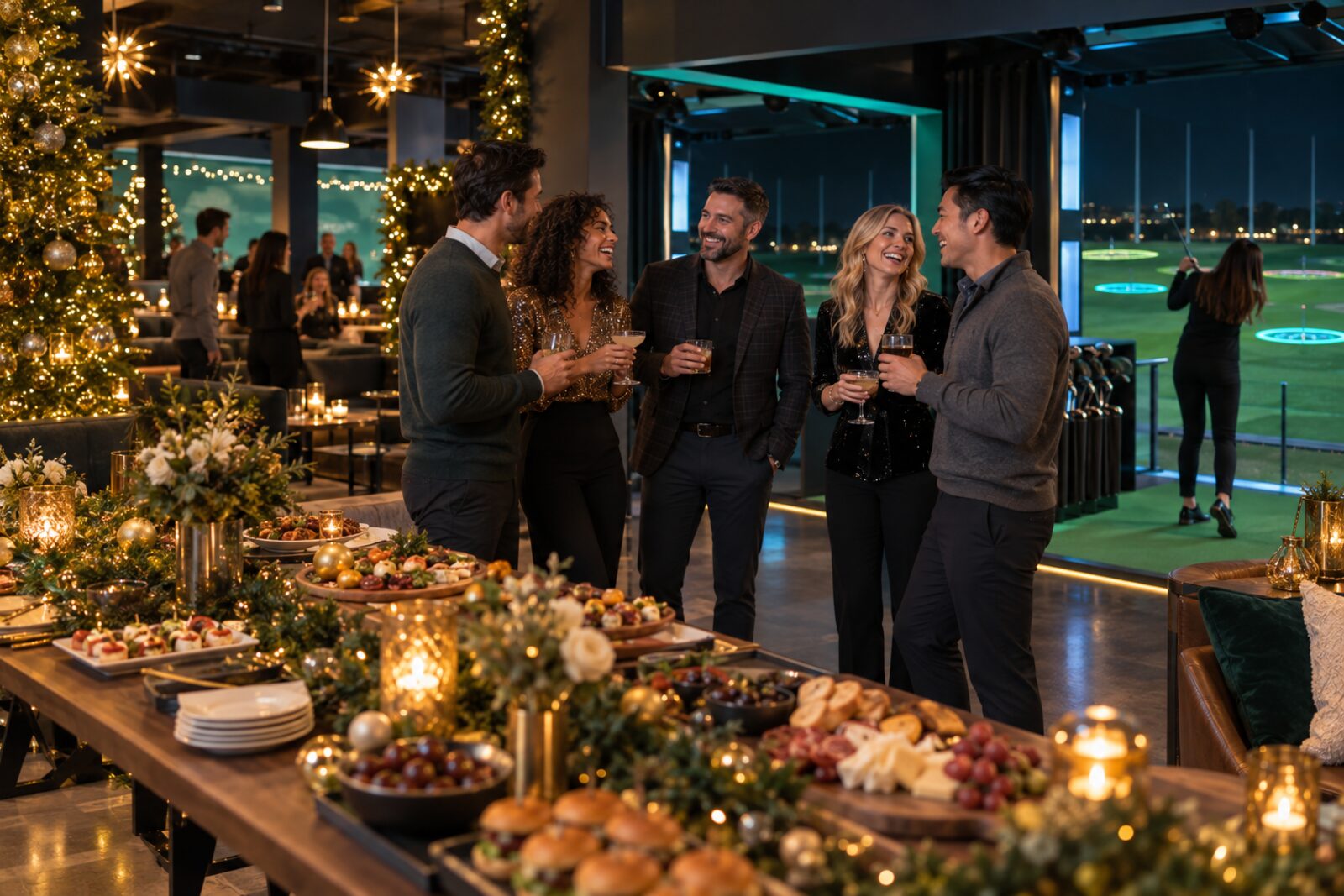
The alternative is to plan one shoot per quarter, scheduled deliberately on a night that looks the way the venue wants to be seen: full, lit, in use, with the food and drink present. For the fourth quarter that means holiday dressing, a catering spread, a corporate group in the space and a gift card in frame.
One planned shoot produces the images for the season’s ads, social posts, occasion pages, email and gift card artwork. It also prevents the most common visual problem on venue websites, which is a gallery assembled from whatever happened to be photographed over three years at wildly different quality levels.
Shoot for the formats the content will actually use: vertical video for social, wide crops for page headers, clean product shots for gift cards, and at least a few images with visible people rather than empty rooms. An empty room shows the facility. A busy room sells the night.
Treat the Google listing as a booking page
For a venue, the Google Business Profile is frequently the first and sometimes the only page a customer sees.
Someone searching for a place to take a group looks at the photos, the rating, the hours and the phone number, then decides whether to click through at all. That makes the listing a booking surface rather than a directory entry.
Going into the fourth quarter, get the details right before the traffic arrives:
- Holiday hours, including closures and late openings, entered in advance
- Photos refreshed from the new shoot, with the interior clearly represented
- Attributes and services that match what the venue actually offers to groups
- A booking or enquiry link pointed at the relevant page, not the homepage
- Questions and answers seeded with the real logistics organizers ask about
- Posts covering the seasonal offers while they are live
Structured data on the website helps search engines connect the listing to the site. Google documents the relevant markup for venues in its guidance on local business structured data.
Venues that draw from several surrounding communities have an additional problem worth reading about separately, which our guide to local SEO for service-area businesses covers in detail.
Collect reviews while the room is happy
Reviews do specific work for an experience venue. They tell an organizer that a group like theirs had a good time, and they answer the question no marketing page can answer credibly, which is whether the visit lives up to the photos.
The fourth quarter is the best review-collection window of the year, because volume is high and the visit is memorable. It is also the easiest one to waste, because staff are busy.
Build the request into the operation rather than leaving it to good intentions. That usually means a short link or QR code the team can hand over at the end of the visit, a follow-up message sent the next morning while the experience is fresh, and a habit of asking the group organizer specifically, since their review is the one future organizers will read most closely.
Reply to every review, including the difficult ones. A calm, specific reply to a complaint reassures the next reader more than a wall of five-star ratings with no owner presence at all.
Put paid budget where the intent already exists
Fourth-quarter advertising for a venue does not need to create demand. The demand is already there and already searching. The job is to be present at the moment of comparison.
Three campaign types earn their place for most venues:
- Search, on occasion terms. Phrases built around the occasion and the area, pointed at the matching occasion page. This is the highest-intent traffic a venue can buy, and it is usually cheapest before the season peaks.
- Retargeting, always on. Group organizers research across several sessions and several days. Retargeting keeps the venue in the consideration set through a decision that is rarely made in one sitting.
- One seasonal promotion. A single clear offer with a deadline, supported by the quarter’s photography and a page built for it.
Budget follows the lead time. Corporate campaigns should ramp in October and taper as the available dates fill, because spend on a fully booked week is wasted. Gift card campaigns do the opposite and peak in the final ten days before the holidays, when late buyers are looking for something to give.
Keep the offer in one place. When the ad, the page and the listing disagree about the price, the organizer stops trusting all three.
Sell gift cards as a second product
Gift cards solve a real problem for an experience venue, which is that the fourth quarter has more demand than the calendar has capacity.
A gift card converts interest that cannot be seated in December into revenue now and a visit in January or February, which is often the quietest stretch of the year. It also reaches a buyer the venue cannot otherwise sell to: someone who is not coming, has never visited, and simply needs a good gift.
Treat it as a product rather than a footnote. It needs its own page, a purchase path that works in a few taps on a phone, artwork that looks like a gift, and clear information about how the card is delivered and redeemed. Digital delivery matters most in the final week, when the buyer needs something that arrives immediately.
Then plan the redemption. A stack of unredeemed cards in January is an opportunity, and a reminder sent in the slow season converts them into visits during the weeks that need the traffic.
Answer the questions that stall a group booking
Every venue has a list of questions the staff answer on the phone several times a day. Each one is a question the website could have answered before the organizer had to ask.
Gather that list from whoever handles enquiries, then answer the questions in plain language on the relevant occasion page. Common ones for experience venues include parking and accessibility, whether outside food or cake is allowed, minimum and maximum group sizes, what happens with a late arrival, whether the space can be private, age restrictions, deposit and cancellation terms, and how long to allow for the whole visit.
This is not only a service improvement. Unanswered logistics are a leading cause of abandoned enquiries, because an organizer who cannot confirm that a venue works for their group will quietly move to one that made it obvious.
Measure bookings, not reach
Reach and impressions describe activity. A venue needs to know whether the calendar filled.
Track the small number of measures that connect marketing to revenue:
- Enquiries and completed bookings by occasion type
- Calls from the website and from the Google listing
- Cost per booked group, by campaign
- Gift card sales, and redemptions in the following quarter
- Average group size and average value per booking
- Response time to enquiries, and the share that convert
- Reviews collected per hundred visits
Review these by occasion rather than in aggregate. A corporate booking and a walk-in should never be judged by the same cost per enquiry, because they are not worth the same amount. The purpose of the reporting is to answer one question before the next season: which occasions deserve more of the budget, and which pages are getting in the way.
What this looked like for Digital Golf Fort Erie
Digital Golf Fort Erie is an indoor golf venue in Fort Erie that sells casual bookings, leagues, group experiences and birthday parties.
The starting position was a common one for an experience venue. The facility was good, the website could not take a party enquiry cleanly, and the business had no review presence at all, which meant a first-time visitor comparing options had nothing to reassure them.
The work concentrated on the booking path and the local visibility around it: a rebuilt website with a dedicated birthday party page, a booking form that works on a phone, an on-location photoshoot that produced real images of the space in use, a social calendar built from those images, Google Ads pointed at the pages that sell a specific occasion, and a review strategy the team could actually run during a busy shift.
The review count moved from zero to 17 at a 5.0 average, and the highest-performing social post reached more than 13,000 views. The structural change mattered more than either number: enquiries now arrive through a path built for them instead of through a general contact form.
Read the Digital Golf Fort Erie case study for the full breakdown of the website, social, review and advertising work.
Fourth-quarter checklist for an experience venue
Work through this list before the season rather than during it:
- Write down the real lead time for each booking type the venue sells.
- Set promotion launch dates one full lead time ahead of the dates they sell.
- Build a separate page for each occasion worth pursuing this quarter.
- Rewrite group copy to answer the organizer’s logistics, not just the atmosphere.
- Test the full enquiry path on a phone, on mobile data.
- Cut the enquiry form to fields an organizer can answer today.
- Book one seasonal photoshoot on a night that looks busy.
- Enter holiday hours and refresh the photos on the Google Business Profile.
- Point the listing’s booking link at the relevant page.
- Put a review request into the end of the visit, and reply to every review.
- Run search on occasion terms, retargeting always on, and one seasonal offer.
- Give gift cards a real page and a phone-friendly purchase path.
- Publish answers to the questions the phone team repeats daily.
- Agree how bookings, calls and gift card sales will be tracked before spend starts.
- Book the first-quarter shoot before the fourth quarter ends.
Nobody completes all fifteen in a week. The order above is roughly the order of impact, so the first four items are worth more than the last four if time is short.
Plan the season while there are still dates to sell
A venue’s busiest quarter is won in the quiet weeks before it, in the pages that explain a group booking clearly, the photography that makes a night look worth choosing, and the ad spend that shows up while the organizer is still deciding.
Uncommon works with experience venues on exactly that cadence: one shoot a quarter, a social calendar and ad plan built around the season the venue is actually selling, and a monthly report that reports bookings rather than impressions. See how we approach marketing for experience venues, or talk to the team about the next quarter.